
Why Does Supervision Feel Like Something to Get Through When It’s Meant to Keep Us Safe?
- catherinedrewer
- Apr 29
- 4 min read
I’ve been thinking about supervision a lot recently, not in a theoretical way, but in the way it shows up in practice.
There’s a version of supervision we all talk about. Reflective, containing, ethical, somewhere you can think things through properly and not carry the work on your own. Most of us were trained with that idea in mind, and if we supervise others, it’s probably what we aim to offer.

But when you listen to how supervision is actually experienced, it doesn’t always sound like that.
I hear people describe it as something they have to do rather than something that supports them. It can feel exposing, sometimes a bit heavy, occasionally frustrating, and for some, not always that useful. There’s often a sense of managing what gets brought, choosing words carefully, holding things back just enough to stay on safe ground.
And when that’s the experience, it makes sense that people become cautious in supervision. You don’t bring the bits you’re unsure about, or the moments you didn’t handle well, or the feelings you’re not proud of. You bring something more considered, more contained.
But that’s not really the work because supervision isn’t meant to be about presenting your practice well. It’s meant to be the place where you can take it apart a bit, look at what is actually happening, and be honest about the parts that feel unclear or uncomfortable so that we can understand and grow.
Somewhere along the way:
Somewhere along the way, I think that’s been diluted, not lost completely, but enough that there’s now a gap between what supervision is meant to be and how it’s often experienced; and I don’t think we can ignore that.
Supervision does hold a level of hierarchy. It has to. It carries responsibility. It’s where accountability sits, where ethical thinking is shaped, and where decisions that affect client safety are sometimes held and challenged. That in itself isn’t the problem. When it’s done well, that structure feels containing rather than restrictive. It gives the work a sense of weight and care.
But when that purpose isn’t clear, or when the relationship doesn’t feel safe enough to hold it, that same structure can feel like judgement. And once supervision feels like judgement, people protect themselves. They edit what they bring. They soften the edges. They stay away from the things that feel most exposed; but those are usually the things that most need supervision.
I also think we underestimate how much the relationship matters here.
We talk a lot about the therapeutic relationship, but the supervisory relationship carries its own weight. Without trust, without a sense that you can be met as a person rather than assessed as a practitioner, supervision can quickly become something performative. You say the right things, reflect in the right way, maybe even sound like you’re doing the work, but underneath it, you’re still holding quite a lot back.

And if that’s happening, supervision isn’t really doing what it’s there to do. Because the work that needs supervision isn’t the tidy, well-formed material. It’s the moments where you’re not quite sure what you were doing, or why you reacted the way you did, or whether you missed something important. If those parts aren’t making it into the room, then something is off. So maybe the question isn’t why people don’t value supervision, but what people are actually experiencing when they sit in it.
If it doesn’t feel like a place where you can be honest, then it will be approached with caution. And if it’s approached with caution, it will start to feel like a requirement rather than a resource. If it is approached with fear it will start to be something that feeds a sense of inadequacy, of not being good enough.
And that’s a problem, because supervision is one of the things that keeps our practice safe.
Not just in a procedural sense, but in a very human one. It’s where we notice what we might be missing. Where we slow things down enough to really think and where we can say “I’m not sure” without that meaning we’ve failed.
When supervision is working well, there’s something about it that feels steadying. Not always comfortable, but containing in a way that lets you breathe a bit more in the work.
You leave clearer, not because someone has told you what to do, but because you’ve had the space to properly reflect. You have taken time to connect with your authenticity in the therapeutic space and remind yourself that being a human is what matters. And in a profession where so much is held internally, that matters a lot more than we sometimes acknowledge.
So maybe part of this is about being a bit more honest about supervision. About how it feels, what isn’t working, and what we need from it.
Not to undermine it, but to bring it back to what it’s meant to be.
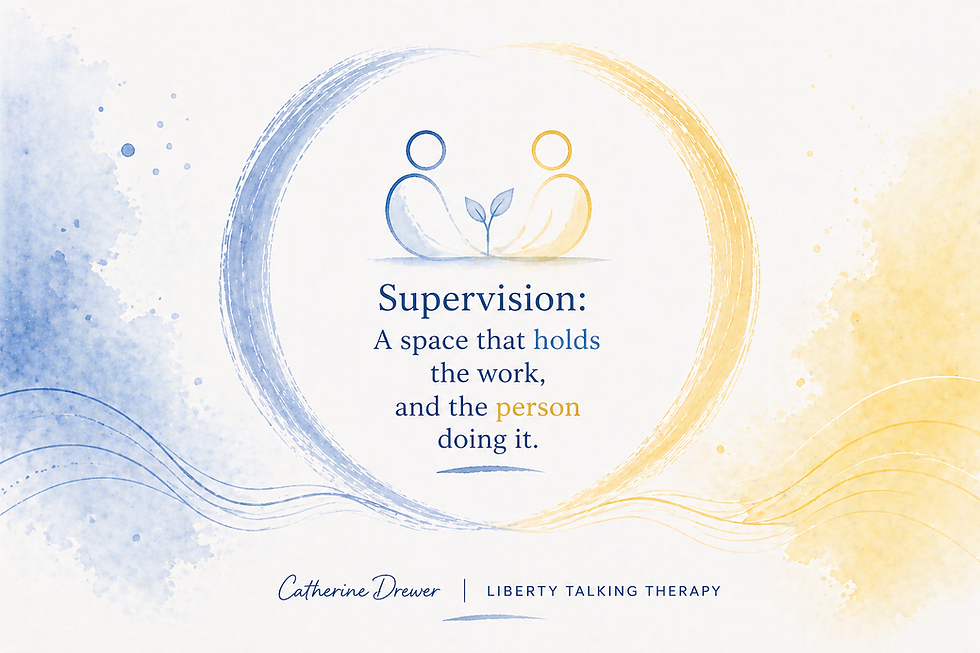
Catherine is a Supervisor and a trainer of Supervisors and contributed to the Good Practice Guide to Supervision for the NCPS. If you think this is the supervisor space you would like then get in touch


Comments